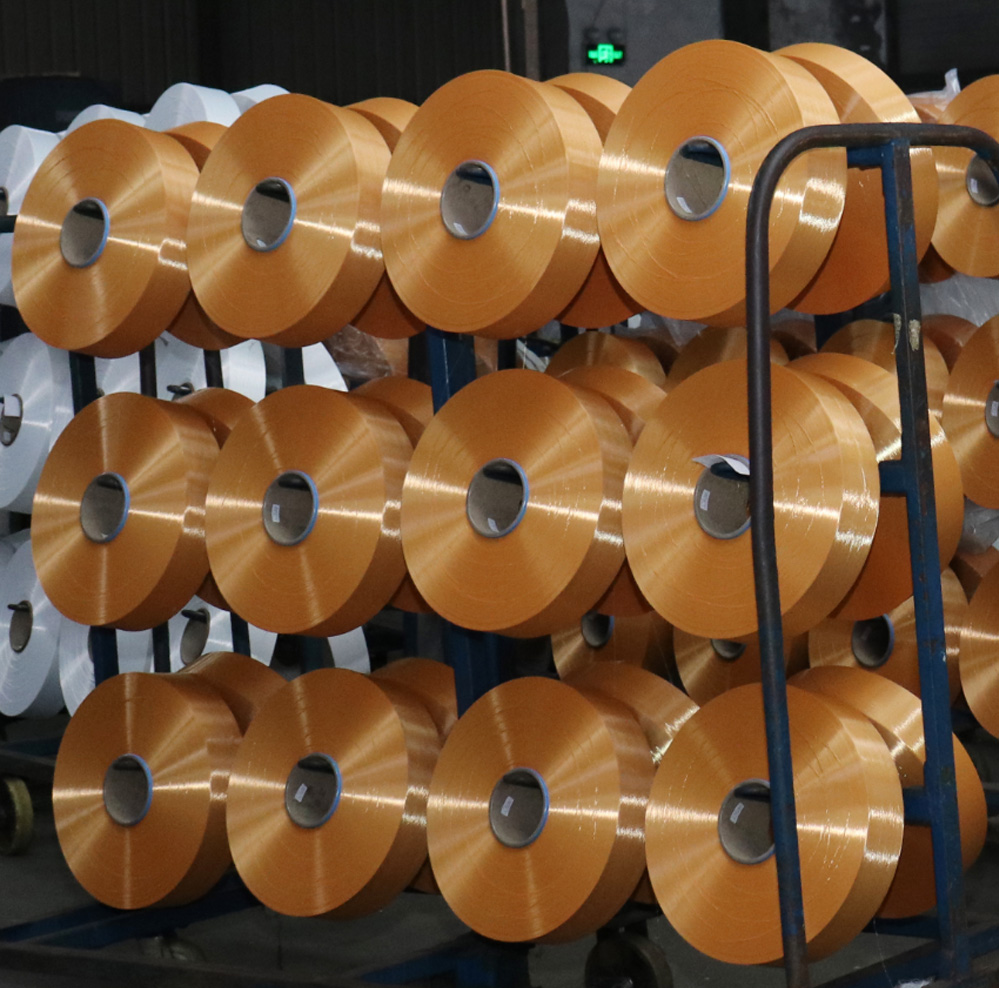
polyester filament
Polyester Filament Yarn (PFY) is produced using purified terephthalic acid (PTA) and ethylene glycol (MEG) as core raw materials, through direct esterification and continuous polycondensation reactions to obtain a high-purity polyethylene terephthalate (PET) melt. This melt undergoes precise processing through melt spinning, cooling and forming, and stretching, resulting in continuous fiber tow with a length of up to over a kilometer.
Its appearance presents a smooth and flat morphology, with a bright luster and a touch similar to that of real silk. The surface is free of fuzz and has a uniform and dense structure. In terms of physical properties, the native polyester filament exhibits extremely high breaking strength and excellent wear resistance; it also possesses excellent elastic recovery and wrinkle resistance, with excellent dimensional stability. Furthermore, it has excellent heat resistance and thermal stability, good lightfastness, and good corrosion resistance to most chemical reagents.
Based on different processing techniques, primary polyester filaments are primarily categorized into various types such as pre-oriented yarn (POY), fully drawn yarn (FDY), and drawn textured yarn (DTY) to meet diverse textile needs. Their applications are extremely wide-ranging: in the apparel and textile sector, they are the preferred material for manufacturing sportswear, high-end shirts, dresses, suit fabrics, and various linings; in home decor, they are commonly used for making curtains, sofa covers, carpets, and outer fabrics for bedding; in the industrial and technical textiles sector, they are heavily utilized in the production of key components such as tire cord, seat belts, airbags, conveyor belts, ropes, and high-strength filtration media.